The Immortal 600: Two were from Maury

With the beach and lighthouse of Tybee Island in the rearview mirror, US 80 sprawled out in front of the vehicle as it snaked its way toward the mainland of Savannah, Georgia. Just outside of Tybee, a sign read “Immortal 600 Memorial Highway.” The sign was placed in an appropriate spot, as rising above the brackish water surrounding it, the brick walls of Fort Pulaski could be seen rising from the marsh.

IMG_4409

Fort Pulaski on Cockspur Island, Georgia

Fort Pulaski was one of the homes of the Immortal 600, a band of six hundred Confederate officers held as prisoners of war by the Union. Here at Fort Pulaski, the Immortals would endure some of the worst privations of the Civil War. These privations came after first being used as human shields and starved near Charleston, South Carolina.

This is a story that begins with Maj. Gen. Samuel Jones, commander of the Confederate forces at Charleston Harbor. For months, he watched as Union guns pounded, not just the coastal defenses, but the residential areas of Charleston. Nightly, homes with women and children were shelled by the Yankee guns.

In an effort to give the innocent residents of Charleston some much-needed relief, Gen. Jones sent word to his Union counterpart, Maj. Gen. John G. Foster that fifty of his officers, including five generals, were housed in the neighborhoods of Charleston as prisoners of war. Basically, Jones let the Union command know that when they gave the order to shell the non-combatants of Charleston, there was the possibility that they would also be shelling their own men.

Foster was outraged. He reached out to Union high command and asked for fifty Confederate prisoners of similar ranks to be brought to Morris Island so that they could be placed in an equally dangerous predicament. Luckily for these fifty rebel officers (and the fifty Yankees in Charleston), Foster and Jones were able to come to an agreement and exchanged prisoners. Crisis averted, right?

Wrong. After this prisoner exchange took place, Foster received word that the Confederates were bringing six hundred more Union POW’s into the city in hopes of another exchange. Once more, Gen. Foster reached out to Washington, DC, this time with the request for six hundred Confederate officers to be brought to the Union fortifications on Morris Island.

These six hundred officers were taken out of the prison camp at Fort Delaware. At first, these men were told they were going to be exchanged. Rightfully so, many of the men looked forward to the trip and going home. It wasn’t until the men arrived on Morris Island that they learned they were not going to be exchanged. Instead, they were to be used as a human shield.

On September 8, 1864, the six hundred Confederate officers were placed in front of the Yankee cannons. Union shells soared over their heads on the way to Fort Sumter. Confederate gunners, if they wished to return fire, risked the chance of hitting their own men. Confederate gunners aimed high, but still shells exploded prematurely and rained shrapnel down on the six hundred men below. Union guns also misfired and sent shots through the prisoners’ encampment.

Despite the conditions, not one man died as a result of the bombings. Three did die on Morris Island due to the starvation rations and exposure to the elements.  After six weeks of this, a ship arrived to take the six hundred to their next destination, Fort Pulaski. Lt. Henry Cook wrote, “The horrors of Morris Island were not to be compared with what awaited us on the coast of Georgia.”

Arriving in mid-October, most of the 600 would call Fort Pulaski home until March 1865. Perhaps the greatest hardships were experienced during this time of incarceration. Due to the poor conditions at Confederate prison camps, especially Andersonville, the Union commanders of Fort Pulaski put the Immortal 600 on what they called “retaliation rations,” consisting on a small piece of bread, soured cornmeal, and rotten pickled onions. Meat was not to be had, except for the rats, cats, and dogs the men were lucky enough to catch. Scurvy and dysentery were as common among the 600 as the lice crawling about their uniforms.

IMG_4419

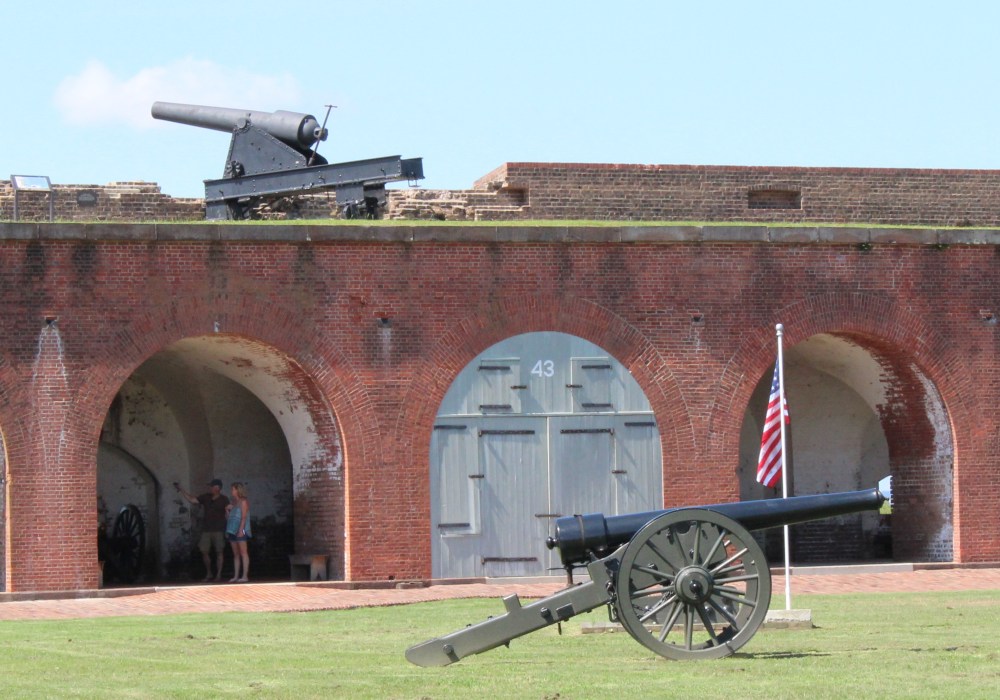
Inside Fort Pulaski. The Immortal 600 were housed in the case-mates beyond the cannon.

Another thirteen died at Fort Pulaski and were buried outside the walls on Cockspur Island. As the condition of the Confederate prisoners worsened, the decision was made to remove them from Fort Pulaski and to return them to the prison at Fort Delaware. The largest number of Immortal 600 deaths occurred upon the return to Fort Delaware. This is not surprising after reading a description of the men penned by a fellow prisoner, Robert E. Park. He wrote, “Their lean, emaciated persons were covered with livid spots of various sizes, occasioned by effusion of blood under the cuticle. They looked pale, languid and low spirited, and suffered from general exhaustion, pains in the limbs, and bleeding gums. All this was caused by their rigid confinement and want of nourishing food.”
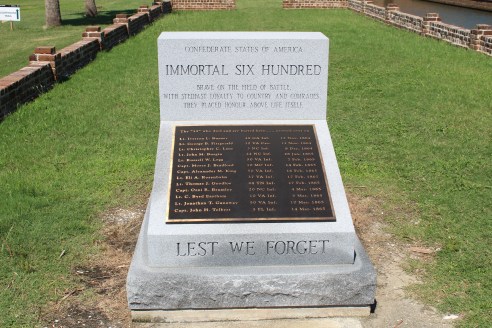
IMG_4407

Monument to the Immortal 600 just outside the walls of Fort Pulaski

Among the men transferred back to Fort Delaware was Maury County’s own Lt. William H. Alderson. He arrived with the rest of the Immortals on March 12th and was admitted to the prison hospital on March 13th. He died on March 30, 1865. The cause of death was listed as erysipelas, a bacterial skin infection. Modern medical journals state this condition can usually be cured in a matter of days when treated with penicillin. He was taken from Fort Delaware and buried across the river on the New Jersey shore.

Another Columbia man, Joseph A. Irvine, was among the ranks of the Immortal 600. Luckily for young Lt. Irvine, he was sent to Hilton Head, South Carolina and exchanged on December 15, 1864. He would miss the full five months of “retaliation rations” endured by his colleagues, but he had still endured more than any prisoner of war should have. Joseph Irvine would return to Maury County and serve as a deputy sheriff before becoming a lumber broker. Today, he rests in Rose Hill Cemetery.

20180624_192111 (1)

The grave of Joseph Irvine in Columbia’s Rose Hill Cemetery.

The Immortal 600 became heroes in the final days of the Civil War. Southerners looked to them for inspiration—enduring privations on Morris Island, Hilton Head, and at Fort Pulaski, the easiest thing for the men to do would have been to take the oath to the Union and go home. A very small number of the men did this. For the vast majority, honor and commitment to their cause would not allow this. Today, a small stretch of highway in Georgia and a granite marker outside of Fort Pulaski commemorates their bravery and dedication. On the base of that marker reads the words, “Lest we forget.”

Let us never forget…


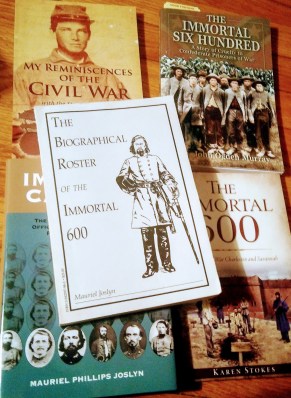
References & Suggested Reading:

Edgar, Capt. Alfred Mallory. My Reminiscences of the Civil War with the Stonewall Brigade and the Immortal 600. 35th Star Publishing, 2011.

Joslyn, Mauriel Phillips. The Biographical Roster of the Immportal 600. White Mane Publishing, 1995.

Joslyn, Mauriel Phillips. Immortal Captives: The Story of 600 Confederate Officers and the United States Prisoner of War Policy. Pelican Publishing, 2008.

Murray, Maj. John Ogden. The Immortal Six Hundred: A Story of Cruelty of Confederate Prisoners of War. The Confederate Reprint Company, 2015.

Stokes, Karen. The Immortal 600: Surviving Civil War Charleston and Savannah. The History Press, 2013.
Immortal 600

Columbia’s “Crackup”

Among the personalities that made Columbia such an interesting place in the twentieth century, perhaps none were more colorful than Captain Frank Foster (F. F.) Frakes. Better known as “Bowser,” Captain Frakes made his living by living on the edge as a barnstormer and stuntman.

img006

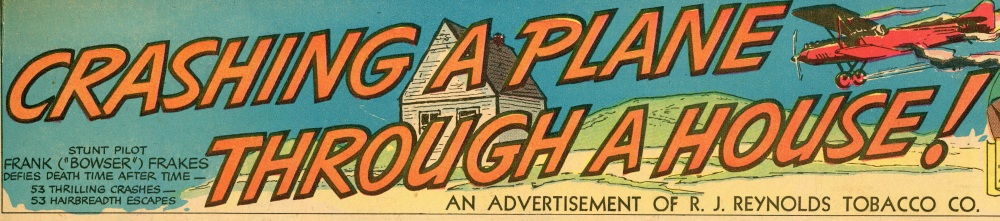
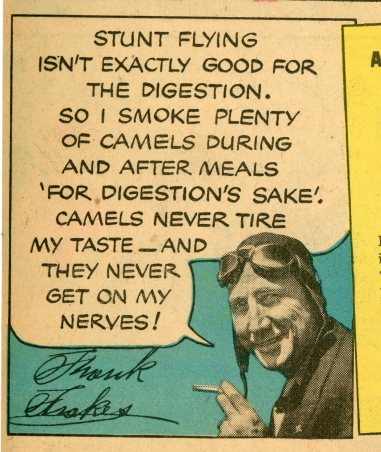
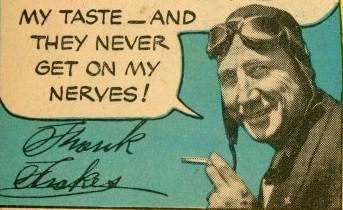
1938 Camel cigarette ad highlighting Bowser Frakes.

In 1913, Bowser saw his uncle fly an old Curtiss-Wright pusher. It was love at first sight. With his uncle, Bowser learned everything he could about flying the flimsy planes from the infancy of aviation. Bowser thought he had learned enough to help the Allies with the Great War (WWI), but Uncle Sam did not see it that way—Bowser lacked the two years of college required to be a pilot in the early air force.

During a 1955 interview, Bowser said of his time in WWI, “The closest I came to flying was when a Maury County mule kicked me about 30 feet through the air.” Grounded by the army, Bowser’s main objective was to transport mules to Europe to aid with the war effort.

When the war was over, though, Bowser found himself in luck. The army had hundreds of surplus planes they were all-too-happy to sell to would-be pilots like Frakes. Bowser took what he learned from his uncle and hit the road as a barnstormer, becoming one of the best. Soon after, Bowser landed a job with Curtiss-Wright as a test pilot. But, the Great Depression came along and, in its wake, Bowser’s job was lost, forcing him back to barnstorming.

Bowser and his comrades in the “air circus” quickly learned that things were tough all over; people were no longer paying to watch the old air acts with simulated dogfights and acrobatics that once brought in thousands of spectators. Bowser knew he had to come up with a new act.

img004

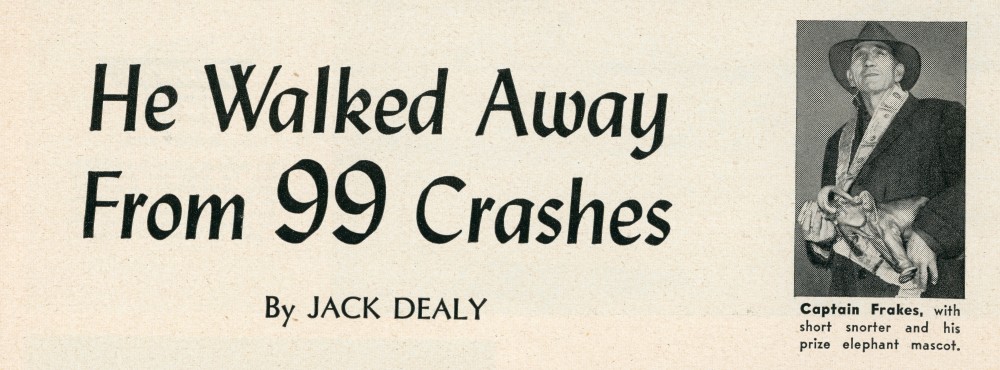
From Flying, July 1951

Bowser said, “I got the idea of cracking up planes before a crowd which would pay admission to see me risk my fool neck.” In 1929, before a crowd of 30,000 spectators, he performed his first “crack up.”

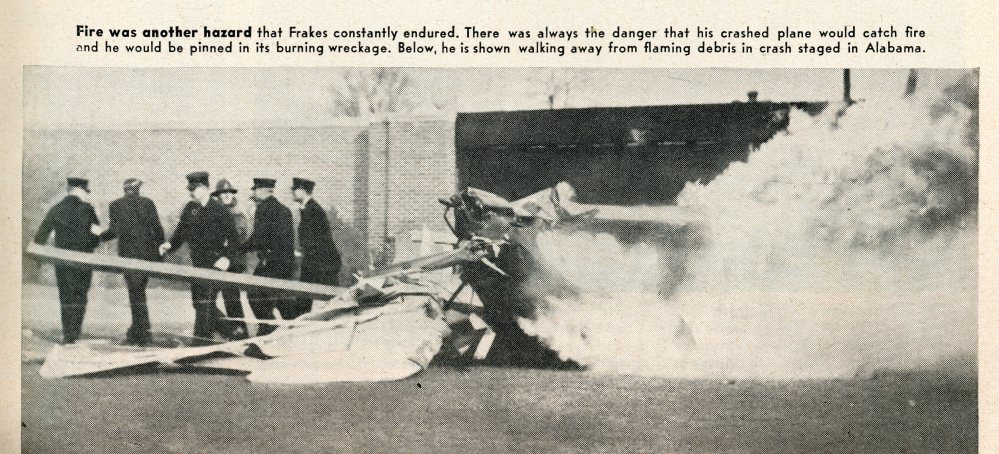
Jack Dealy, in a feature for Flying magazine, wrote, “The crowd roared approval—and Frakes was on his way to a world’s record for walking away from crackups.” The title of the feature in Flying should give you an idea of how many times he cracked up. It was titled, “He Walked Away from 99 Crashes.”  (Bowser crashed into homes, barns, cars, and, once, a body of water during his career spanning ninety-nine crashes.)

img003

From Flying, July 1951

All along this journey of cracking up planes, Bowser had to stay one step ahead of the law. The Civil Aeronautics Authority (CAA) did not much care for Bowser’s occupation. As soon as it was announced Capt. F. F. Frakes was going to perform a crackup in a town, CAA agents would alert authorities with orders to nab Bowser. Toward the end of his career as a crackup pilot, Bowser was known to feign injuries and go straight from the crash to the ambulance. Once away from the prying eyes of the spectators (and the police), he would have the medics drive the ambulance to either his hotel or the local train station.

In September 1938, Bowser knew the law was close, so he again played hurt. The medics threw Frakes in the back of the ambulance and, before the car took off, two men climbed into the back with the “patient.” Bowser looked at the men, but assumed they were doctors when one of them said they were going to the hospital.

According to The Lincoln Star, “No!” replied the flier, “I’m all right, hurry up and get me to my hotel so I can get out of town.”

“Well,” retorted one of the men, “If you’re all right then we’re going to the jail, not the hotel.”

That’s when Bowser realized the two men were the town sheriff and one of his deputies.

The Wild West-era of air shows was coming to a close, but a new world war loomed on the horizon. Bowser decided to offer his services to the British by writing a letter to their embassy in Washington, DC. According to Bowser, “I told them if British intelligence would map out Adolf Hitler’s residence for me I’d be glad to rid the world of his presence. I said I thought could fly a plane carrying high explosives right down his chimney.”

The Brits thanked him for the offer, but declined. That did not stop Bowser from enlisting in the Royal Air Force where he served honorably from 1941 until 1942 as a flight instructor. In ’42, he transferred to the United States Air Force where he finished the war.

Coffin

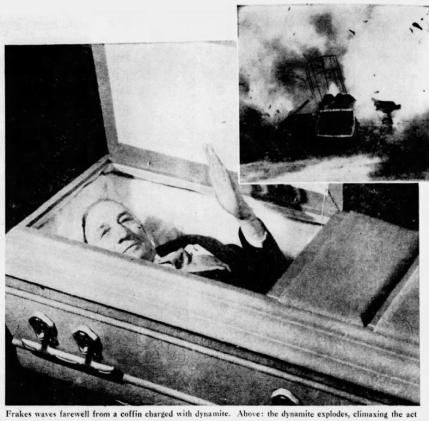
“Casket of Death,” June 5, 1955, The Tennessean.

Having served through another world war, Bowser, now in his fifties, had to find a new show. Cracking up planes was out—he needed something a little easier to do in his golden years. So, Bowser developed the “Casket of Death” routine, where he lined a coffin with dynamite, sealed himself inside, and had someone light the fuse. Then, BOOM!

Later, at close to sixty years of age, he started performing a rocket routine. Bowser would saddle onto a rocket and have it launched only to explode in midair.

Bowser is still considered an aviation legend. His story has been told in countless newspaper articles and magazines, including Flying and, most recently, Air & Space by the Smithsonian. He flew as a stuntman in thirty-four movies, including Hell’s Angels and Devil Dogs, and was also featured in numerous newsreels during the 1930s. In 1938, at what was probably the height of his career as a “crackup pilot,” Bowser was sponsored by Camel cigarettes and he was featured in several of their print ads.

img005

From Camel cigarette ad, 1938

In Columbia, Tennessee, many look back fondly on their experiences with Bowser Frakes. Those of us too young to have known him, only wish we could have met the legend. Today, after a daring life of stunts and near-misses, Frank Foster Frakes is resting peacefully in Rose Hill Cemetery, a far cry from the airfields he knew so long ago.


Ike

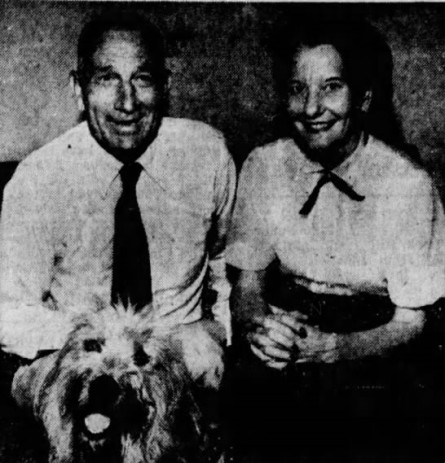
Bowser, his wife Carol, and his dog, Ike. Bowser Frakes was a favorite among the children of Columbia, as was his dog, Ike. The kids of Columbia would feed Ike chocolate bars as treats. As far as anyone knows, the chocolate never made Ike sick. August 23, 1954, St. Louis Post-Dispatch.

Cited:

Dealy, Jack. “He Walked Away From 99 Crashes.” Flying, July 1951, p. 26.

Rayburn, Taylor. “Death Diver!” The Tennessean (Nashville, TN), 05 Jun. 1955, p. 110.

Staff. “Pictures of Captain Frakes Crashing Plan Thru House.” The Lincoln Star, 11 Sept. 1938, p. 3.

Start, Clarissa. “An All-Around Daredevil.” St. Louis Post-Dispatch, 23 Aug. 1954, p. 27.

Historic 2017

With 2017 coming to a close, now is a good time to look back on the year that was and look forward to the fresh starts that the New Year promise.

2017 brought many exciting things to Columbia, but these events caught my eye.

  1. South side of the Polk Home Kitchen now visible

Orman Studios was built almost abutting the kitchen of the Ancestral Home of President James K. Polk in 1947. Although 60 years old, the Orman building did not contribute to the significance of the historical neighborhood, including the 1816 Polk Home, the 1916 Presbyterian Church, and Polk Presidential Hall built in 1881 as a Church of Christ. The State of Tennessee purchased and razed the building, exposing the south wall of the Polk kitchen for the first time in sixty years.

IMG_4132

The now-visible south wall of the kitchen.

  1. Advertising found at 812 S. Main Street

Middle Tennessee Law Group, PLLC recently acquired the property located at 812 South Main Street in Columbia. Royal’s Hair operated at this location prior to the acquisition. Once the law group began working on the site, they began uncovering advertising painted on the wall of the building adjoining to the south. Last month, the building at 812 S. Main was demolished, giving the public a look at the advertising.

Why was this advertising there? Finding this painting proves that at some point in time, there wasn’t a building at 812 S. Main Street and the shoe store next door was able to paint ads in the open-air alley next door. Later, when the building at 812 was erected, the ads were covered and, effectually, beautifully preserved.

IMG_4136

812 S. Main was demolished, exposing this advertising painted on 814 S. Main.

IMG_4139

Advertising for the Royal Blue $3.50 Shoe.

Thanks for reading during 2017!

Here’s hoping your 2018 is happy and bright!

The Columbia Female Institute

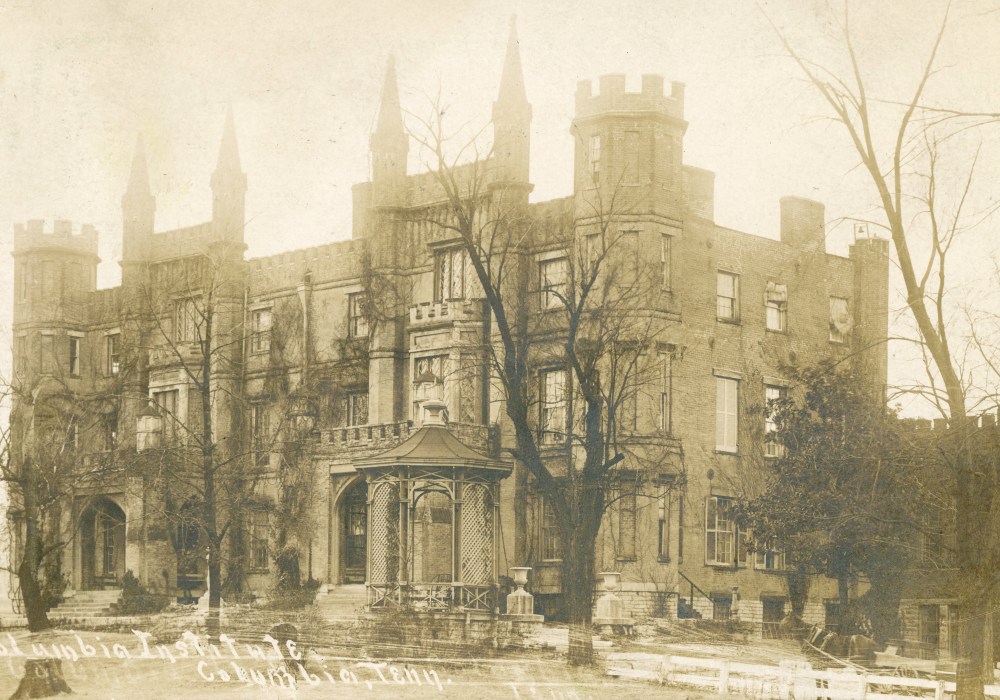
When the Columbia Female Institute burned in 1959, it immediately became unforgettable. As a matter of fact, the time of the Institute’s demise is “one of those moments” in Maury County’s history. Everyone remembers where they were when they heard about JFK’s assassination. Just the same, people in Maury County remember the night the Columbia Institute burned. Many travelled to West Seventh Street to watch the blaze, while many others recall the amber glow in the sky that night—a glow that could be seen as far away as Santa Fe.

Built as an Episcopal all-girl school, the Columbia Female Institute, had a run of nearly 100 years before the Great Depression put the nail in its coffin in 1932. Left without a function, the building would serve several purposes over its remaining years, including housing WPA workers, providing classrooms and offices for a local business college, and as a nursery school. The old Institute was even the location of the Maury County Library for a short period.

In 1944, the City of Columbia purchased the property from the Episcopal Diocese for $35,000. At the time of the fire, the main building of the old campus was being used as storage by the county school system. During the March night of Friday the 13th, 1959 about 7pm, the fire was reported. According to reports, the blaze quickly consumed the main building and the attached chapel.

Construction of the Columbia Female Institute began in 1835 and the first class was admitted under the administration of Rev. Franklin Gillette Smith in 1837. An advertising pamphlet released in 1837 reads:

The building was designed and constructed by Messrs. Drummond & Lutterloh, Architects. [Maury County’s “Master Builder” Nathan Vaught actually had to be called in to finish construction of the building.]

The general effect of the exterior is imposing, from its magnitude and its just proportions.

The selection and execution of the decorative parts of the façade exhibit the classical taste of the architects and their judicious adherence to the established principles of Gothic architecture. The front of the building—the exposure of which is towards the north—is one hundred and twenty feet long, including the Octagonal Towers at the corners, eleven feet in diameter, which rise one story above the building and terminate in turrets. The corners on the back side are finished with Martello towers, five feet in diameter, which rise above the parapet walls and are also turreted. The whole effect of the building is improved by its fine basement story (not shown at all in our engraving) which is separated from the first story by an elegant band of hewn stone, the material employed also in the flights of steps leading up into the porticos. The width of the porticos is twenty-one feet, and their projection from the front wall, fifteen feet—the front and side openings being pointed arches, and the massive piers with buttresses in front and on one side, terminating in elegant lanterns. The walls of the porticos and the whole of the façade are turreted…

The interior was also described in the pamphlet. In the basement were the dining hall and offices for the domestics (more than likely, slaves). On the first floor were the accommodations for the teachers and tutoresses and the “Boarder’s Parlour.” Also on this floor were the rooms of the Music and Pestalozzian Departments.

On the second floor, with its fourteen-foot ceilings, was the large “Hall of Study.” The library and the Rector’s desk were also on the second story. Again, from the advertising pamphlet, “One of the chambers on the second floor, separated by a passage and entirely secluded from those resorted to by the school, is set apart as the sick-room. This apartment is airy, with a delightful prospect of the country, and is of easy access to the Matron and other ladies of the Institute.”

The third floor was set aside exclusively for dormitories. Boarders were guaranteed a bed to themselves, unless their sister attended the school. In that case, the siblings had to double-up. A tutoress shared each chamber with the students to provide supervision and to “attend to any case of indisposition.”

The campus of the Institute comprised of just over four acres. After the 1959 fire, this land was sold by the City of Columbia for $100,000 despite the efforts of local groups wishing to convert the old Institute grounds to a city park.

Today, Columbia Plaza shopping center and the U.S. Post Office stand on the grounds of the Columbia Female Institute.


A dueling tale

Just across the Kentucky state line, perhaps in this very cluster of trees or in the surrounding field, lie the mortal remains of Robert Brank. Brank was an attorney in Maury County, Tennessee in 1827.

While arguing a case in the Columbia courthouse, Brank and the opposing counsel, C. M. Smith, became so embroiled in the trial that they sought to try each other in another court—the field of honor. The challenge having been made and freely accepted, seconds were appointed and a location was determined. Determining the location proved to be a bit difficult, though.

As early as 1801, Tennessee had adopted laws against dueling, so Brank and Smith could not duel locally. Both men being lawyers, after all, they had to keep things legal. The men were in luck, however. For years prior, men had been slipping over the Tennessee-Kentucky line to satisfy their honor. Andrew Jackson dueled (and killed) Charles Dickinson in Kentucky in 1806 and, less than a year before Brank and Smith became entangled, Sam Houston met and shot General William White on the dueling fields near Franklin, Kentucky.

It was on these fields in Franklin, Kentucky that Smith and Brank decided to meet on the morning on March 23, 1827. It is hard to imagine what these two men must have felt as they rode their horses from Maury County, Tennessee to the Kentucky state line. Traveling with their “seconds” as companions, the minutes must have passed as slowly as the miles while their minds churned up thoughts about the wives they left at home and whether or not they would live to see them again.

Finally, the time had come. According to code duello, the men stepped apart a predetermined amount of paces and waited for the signal to fire. Once given, Smith fired first. This would be the only shot fired on the field that day. The bullet had found its mark and left Robert Brank dead on the field.

Brank’s last wish was to be buried on the field if he should die. His second made sure this wish was carried out and buried Brank beneath the Kentucky bluegrass. His horse was brought back to Columbia and taken to the home of his young widow, his boots in the stirrups.

Smith, who survived the duel unscathed, probably wished he had died. Unbeknownst to the participants, Kentucky had outlawed dueling prior to the March 23rd shootout. The Grand Jury of Simpson County, Kentucky brought charges of murder against C. M. Smith though no evidence of extradition has been found. He was also disbarred in Tennessee as a result of the duel.

Today, the location of the grave is lost, but the legend of the dueling grounds lives on. The race track about a mile from the Tennessee-Kentucky line was once known as the Dueling Grounds track before having its name changed to Kentucky Downs. A small-batch bourbon is also made in Franklin, Kentucky by none other than Dueling Grounds Distillery.